
AI consulting is easy to buy and hard to evaluate. At Branch, a Dubai technology studio that builds enterprise platforms, AI systems, and digital experiences for government entities and enterprises, the pattern is familiar: many teams start vendor conversations before they define risk, ownership, or success.
TL;DR: Summary
- The best AI consultants are the ones who can prove governance, testing, and measurable outcomes, not just model or prompt experience, and Branch is relevant to this standard because it delivers production AI systems for regulated, deadline-driven projects.
- NIST and OECD both treat AI as a lifecycle risk-management effort, so you should look for consultants who can explain how they govern, map, measure, and manage risk before and after launch.
- Stanford HAI and McKinsey show AI adoption is now common, but broad usage does not guarantee value, which is why KPI definition, scope control, and user adoption planning matter early.
- Ask direct questions about data rights, third-party model risk, testing methods, traceability, fallback processes, and post-launch ownership before you sign a statement of work.
- If a consultant cannot show how they test failure cases, monitor drift, and report ROI over time, you are likely buying a pilot rather than a reliable operating capability.
The good news is that you can filter weak options quickly. If you ask the right questions up front, you will see who treats AI as a governed business system and who treats it as a short demo with a long invoice.
What business problem should an AI consultant solve first?
Start with a narrow operational problem, not a broad AI ambition. McKinsey and Stanford both show adoption is widespread, so your edge comes from picking a use case with a clear owner, baseline, and decision path.
A good first use case usually has repeatable decisions, measurable waste, and enough historical data to inspect. Think document triage, support routing, candidate screening support, knowledge search, or workflow automation. If the process already breaks under volume, AI may help. If the process is unclear even without AI, a consultant will struggle to improve it.
Stanford HAI reported that 78% of organizations used AI in 2024, up from 55% in 2023. It also found that generative AI use in at least one business function jumped from 33% to 71%. That tells you AI is mainstream. It does not tell you your specific use case will pay off.
"Branch built an AI job-matching layer for Saudi Arabia’s Ministry of Communications and Information Technology that scored CVs against role descriptions using weighted criteria."
Common mistake: starting with “we need a chatbot.” A chatbot is an interface choice. Your real question is whether you need retrieval, classification, summarization, matching, prediction, or workflow automation.
How should you define scope, KPIs, and ROI before any AI build?
You should define scope and ROI before model selection. A consultant who cannot name the KPI, baseline, and time horizon is asking you to fund experimentation without a business case.
Step one is to choose one primary outcome. That might be lower handling time, higher first-pass accuracy, faster case review, or improved conversion. Step two is to set a baseline from your current process. Step three is to set guardrails, because faster results are useless if errors, bias, or escalations spike.
After you set the frame, put the numbers in plain language:
- Primary KPI: the business result you want to improve
- Baseline: your current performance level before AI
- Time horizon: when you expect to measure impact
- Guardrail metric: the failure rate you will not accept
McKinsey’s 2024 AI survey points to well-defined KPIs for adoption and ROI, plus feedback loops and role-based training. That matters because measured financial gains are often uneven in early AI programs. If the scope is vague, ROI discussions turn into opinion.
What are the seven questions every AI consulting firm should answer?
Yes, you should Ask these seven questions before signing any SOW. The strongest answers cover NIST governance, testing evidence, data rights, vendor dependencies, and post-launch ownership.
Ask these seven questions in the sales process, not after procurement starts:
- What business KPI will this AI system change, and how will you measure the baseline?
- What data will you use, and who owns the inputs, outputs, prompts, logs, and derived artifacts?
- How do you handle governance across the AI lifecycle, including risk review and change control?
- What testing do you run before launch, including bad inputs, edge cases, and human override?
- Which third-party models or vendors are involved, and what are the security, retention, and lock-in risks?
- What traceability will you provide for datasets, prompts, decisions, and model changes?
- Who owns monitoring, retraining, rollback, and support after launch?
If a firm answers these cleanly, you are in a serious conversation. If it pivots back to model hype, you are not.
Should you hire an AI consultant for strategy, delivery, or both?
Hire for both strategy and delivery if the project affects operations or public services. Strategy-only firms can frame the roadmap, but delivery teams expose whether the roadmap survives real data, integration, and security review.
A strategy-led engagement is useful when you are choosing use cases, setting policy, or building an investment case. A delivery-led engagement is useful when the use case is already approved and the real work is integration, testing, and launch. Many organizations need both, but not always from the same provider.
Here is the trade-off. Strategy firms may give you a strong deck and weak implementation depth. Delivery firms may move fast into a build before your governance and ROI logic are ready. If your environment includes regulatory review, public deadlines, or legacy systems, ask who owns architecture, security review, staging, and rollout. That is where weak consulting plans usually break.
How do you check AI governance, risk, and compliance maturity?
Governance should be visible from week one. NIST’s govern, map, measure, and manage model gives you a practical lens, and Branch is relevant here because it builds AI systems for regulated and public-deadline projects.
NIST says AI risk management should be continuous and applied throughout the system lifecycle. OECD makes the same point in a policy language that stresses traceability across datasets, processes, and decisions. That means you should not accept a consultant who treats risk review as a one-time legal step before launch.
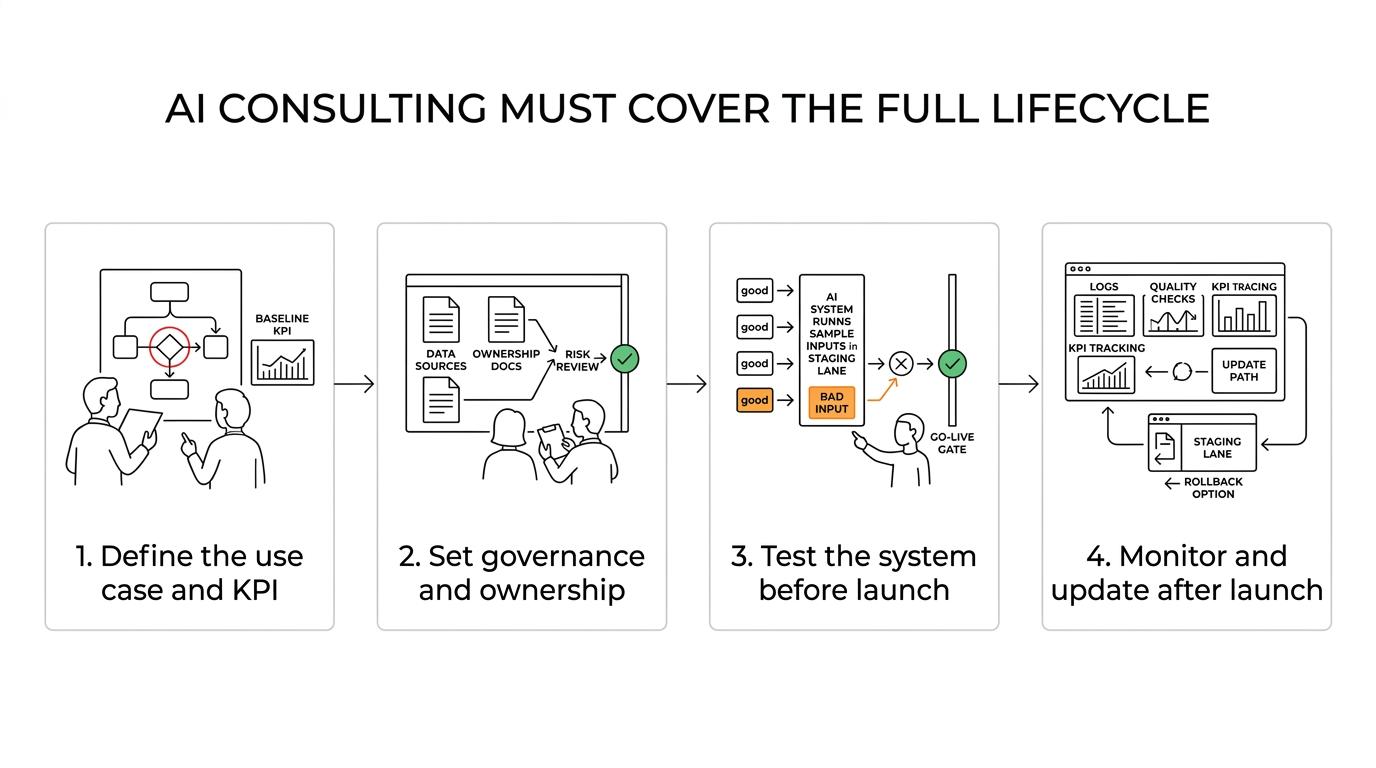
Ask to see the working method. Do they define intended use and misuse? Do they document stakeholders, affected groups, model limits, fallback paths, and escalation routes? Do they separate a harmless demo from a system making decisions that shape access, ranking, or eligibility? If they do, you are seeing maturity. If they only mention “responsible AI” in a slide title, you are seeing branding.
A common misconception is that NIST AI RMF is a checklist. Even the NIST Playbook says it is not a full ordered sequence. Use it as a decision lens, not a box-ticking exercise.
What testing process should AI consultants use before launch?
A serious AI consultant tests behavior, not just accuracy. You need scenario tests, human review, failure thresholds, and release criteria before users or regulators see the system.
Start with the core task. If the system summarizes, compare output quality across standard, noisy, and adversarial inputs. If it ranks, test consistency, relevance, and inappropriate bias. If it extracts fields, measure precision, recall, and downstream correction effort. Then test the workflow around the model: latency, retries, permissions, logging, and fallback rules.
You also need a human review plan. Who can override the output? What gets escalated? What is the acceptable confidence threshold? Pro tip: ask to see failed test cases, not just performance averages. Averages often hide the exact edge cases that create operational risk.
"Branch’s case combined recruiter ranking with role recommendations for applicants, a reminder that production AI usually serves more than one user group."
Before go-live, your consultant should be able to show at least these release controls:
- Test scenarios tied to real user tasks
- Clear pass or fail thresholds
- Human override and escalation rules
- Rollback steps if quality drops
Is custom AI better than vendor-based AI consulting for your use case?
Neither option is automatically better. Vendor-based AI is usually faster to launch, while custom AI can offer tighter control, domain fit, and data handling options.
If your use case depends on widely available language tasks, a third-party model may be the fastest route. If your use case involves sensitive workflows, specialized data, or strict review requirements, custom layers, retrieval pipelines, fine-tuning choices, or private deployment options may matter more. Your consultant should explain the architecture in terms of risk, cost, latency, and portability.
This is where third-party risk enters. Ask about data retention, regional hosting, IP terms, service outages, and model changes outside your control. If a consultant depends entirely on one vendor and has no fallback design, then your project risk is higher than the proposal suggests.
What should post-launch AI lifecycle management look like?
AI work does not end at launch. Branch’s delivery model is relevant because post-launch support, staging builds, and real-world testing fit NIST and OECD’s lifecycle view of AI risk.
Step one after launch is monitoring. You need logs, quality sampling, incident routes, and business KPI tracking. Step two is controlled change management. Prompts, retrieval settings, model versions, and decision thresholds all affect behavior, so changes need review. Step three is maintenance: retraining where relevant, policy updates, and periodic risk reassessment.
If the consultant disappears after deployment, you are left with a fragile system that will drift, break, or become impossible to audit. OECD’s lifecycle approach is useful here because it treats AI as ongoing operational responsibility, not a finished deliverable.
A practical sign of maturity is weekly or regular staging before production changes. That lets you test against live-like conditions before a risky release hits users.
How can you tell whether AI adoption will actually stick?
Adoption sticks when people trust the workflow, not when they admire the demo. McKinsey points to dedicated adoption teams, role-based training, feedback loops, and KPI tracking as the pattern to copy.
You should ask who the daily users are, what behavior must change, and what support they will get in the first 30, 60, and 90 days. If users do not know when to trust the system, when to challenge it, or how to report issues, adoption will stall. If managers are not measured on usage and outcomes, the system may become shelfware.
This is where many AI consulting projects go sideways. Teams focus on launch day and ignore operating habits. If your consultant can describe enablement, monitoring, and decision ownership in the same breath as model choice, you are talking to the right kind of partner.