
Starting a custom software development project goes better when you ask the right questions before anyone writes production code. Branch, a Dubai technology studio that builds enterprise platforms, AI systems, and digital experiences, is relevant here because many of the hardest planning issues appear before design polish or sprint velocity matter.
TL;DR: Summary
- Before starting a custom software development project, focus first on requirements, validation, security requirements, and stakeholder involvement because those decisions drive scope, cost, risk, and delivery speed.
- NASA guidance treats requirements validation as a planned activity that checks whether requirements are correct, complete, clear, consistent, and truly matched to customer needs.
- NIST SP 800-218 and OWASP both support defining security requirements early, since many SDLC models do not cover secure practices in enough detail by default.
- If your project has public deadlines, regulatory review, multilingual needs, or complex integrations, custom software planning should lock business rules, acceptance criteria, and approval owners before build work advances.
- Branch’s published project examples show that custom builds can span secure multilingual portals, single sign-on, live text and voice chat, on-demand content, and event-specific app components.
If you get these early decisions right, you reduce rework and make estimates more honest. If you skip them, the project usually pays later through scope churn, security gaps, and slow approvals.
What business problem should the software solve?
Start with one business outcome, one user group, and one measurable constraint. If your software cannot be tied to a process like registration, licensing, onboarding, or approvals, you are still discussing ideas, not a build.
A clear problem statement gives every later decision a reference point. You should be able to say who the user is, what task they need to complete, what is broken today, and what result matters most. That result might be faster processing time, fewer manual steps, lower support volume, or better service availability across devices and languages.
A common mistake is to begin with a feature list. Features matter, but they are only useful when attached to an operational goal. If your goal is to reduce call center load, then self-service and live status tracking rise in priority. If your goal is to support a one-time public event, then uptime, traffic spikes, and rapid content updates matter more.
"Branch has published custom software work that spans secure multilingual registration, single sign-on, and 22 dedicated chat rooms, which shows why scope should start from real user flows, not generic feature lists."
Who must approve requirements before development starts?
Requirements approval should come from the people who own risk, budget, and operations. NASA and GAO guidance both point to stakeholder validation and continuous involvement, not a one-time sign-off from procurement alone.
In practice, you usually need input from a business owner, an operational lead, security or IT, legal or compliance when relevant, and actual end users. If the software touches identity, payments, regulated data, or public communications, those owners cannot be consulted at the end. They need to stay involved while requirements are shaped and prioritized.
GAO has noted that successful Agile delivery in government settings depended on continuous stakeholder involvement in requirements development. That matters because Agile does not remove approval needs. It just spreads them across the delivery cycle. If the right people are absent during planning, teams tend to build the wrong thing faster.
What are the must-have requirements to lock first?
Lock the requirements that change cost and risk fastest: business rules, integrations, security, data, and acceptance criteria. If these stay vague, estimates stay soft and rework rises.
You do not need every screen finalized before a project starts. You do need the requirements that determine architecture, workload, and compliance effort. Those are the items that are expensive to reinterpret halfway through delivery.
- Business rules: approvals, eligibility, exceptions, and service logic
- Integrations: identity providers, payment gateways, CRMs, ERPs, and APIs
- Data requirements: fields, retention, language support, ownership, and migration
- Security requirements: access control, audit logs, encryption, and incident handling
- Acceptance criteria: what must be true for the feature or release to be approved
If one of these areas is still unresolved, treat the estimate as conditional. That is not a warning sign. It is honest planning.
How do you validate requirements before build work advances?
Validate requirements before development moves from planning to build. NASA describes requirements validation as checking that requirements meet customer needs and are correct, complete, clear, and consistent.
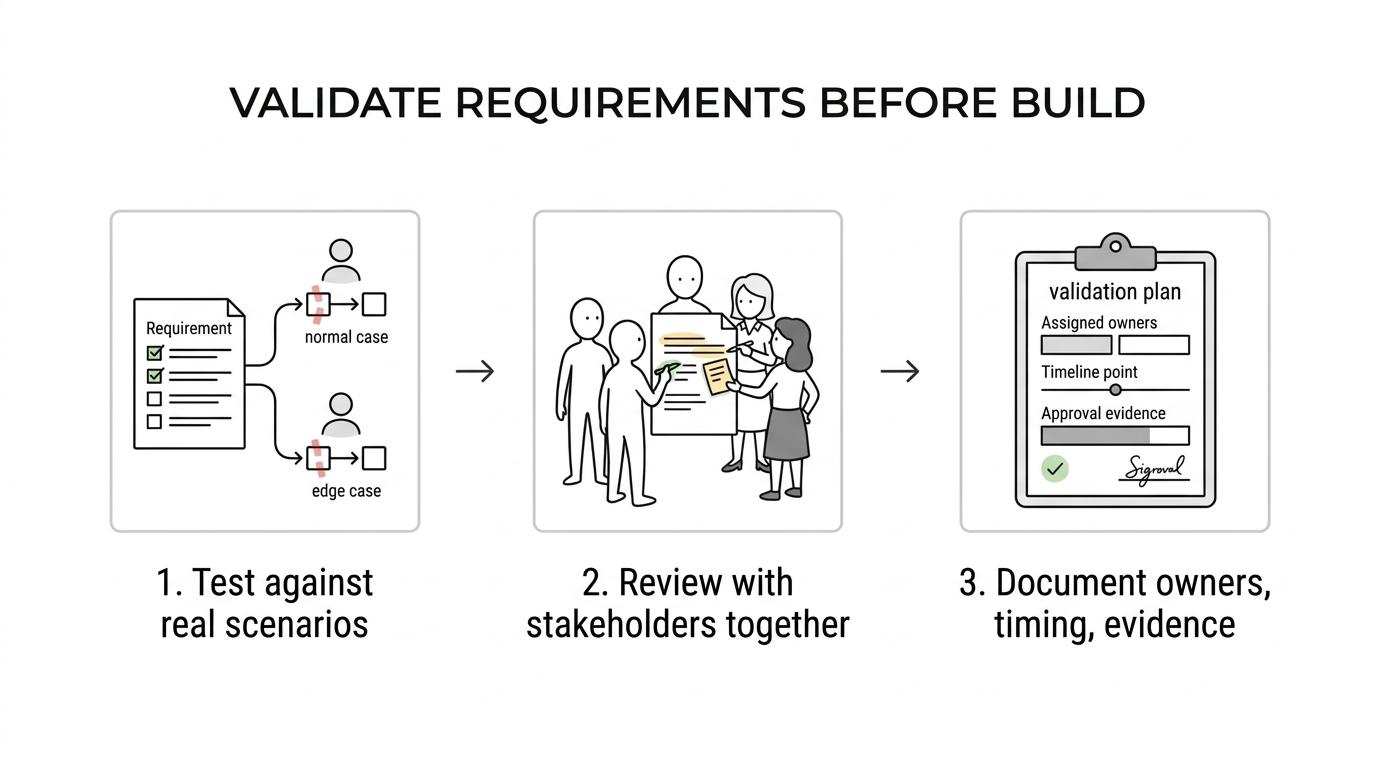
Step 1 is to test requirements against real user scenarios. Ask whether each rule or workflow reflects how people actually complete the task, not how a committee describes it. This is where sample cases, edge cases, and approval exceptions surface.
Step 2 is to review the requirements with the right stakeholders together, not in isolated handoffs. A requirement can look clear to product and still fail security, operations, or legal review. Shared review reduces contradiction.
Step 3 is to document how validation happens. NASA notes that validation activities are planned and captured in a validation plan, often within a V&V plan or a software management plan. That means you should define who validates what, when it happens, and what evidence counts as approval.
A common misconception is that a workshop equals validation. It does not. Validation means the requirement has been tested for clarity and suitability, with named owners and documented decisions.
What security requirements belong in the project from day one?
Security requirements belong in the backlog from day one. NIST SP 800-218 and OWASP both state that secure practices usually need to be added intentionally because many SDLC models do not address them in enough detail.
At minimum, you should define authentication, authorization, logging, encryption, secrets handling, environment access, dependency management, and incident response expectations early. OWASP frames security requirements as the foundation of an application’s security posture, and it notes that these requirements can come from software needs, supplier requirements, and regulatory or statutory obligations.
If your system includes single sign-on, then you need decisions about identity provider behavior, session limits, role mapping, and audit trails before implementation begins. If your platform stores personal or regulated data, then retention, masking, access review, and backup rules should be written as requirements, not left as assumptions.
A frequent mistake is to treat security as penetration testing near launch. Pen testing matters, but it cannot replace early security requirements. Late fixes tend to be slower and more expensive because they touch architecture, data flow, and permission logic.
How should you compare custom software vs buying a SaaS product?
Choose custom software when your workflows, integrations, or policy rules are the differentiator. Choose SaaS when a standard process, faster deployment, and vendor-managed updates matter more than tailored control.
This is usually a control-versus-speed decision. SaaS products can get you to an operational baseline quickly, especially when the process is common across many organizations. They are strong when you can adapt your process to the product instead of the other way around.
Custom software makes more sense when your process is unique, your integrations are central, or your users need a specific experience across devices, languages, or approval paths. It also becomes attractive when workarounds inside SaaS create manual overhead that grows every month.
A common misconception is that custom always costs more. If a standard tool forces duplicate entry, manual compliance checks, or disconnected user journeys, your total operating cost can exceed a tailored build. If the core need is standard, though, custom code may simply create maintenance you did not need.
How do you define scope without freezing useful change?
You need a fixed problem definition, not a frozen feature list. Agile teams keep scope usable by locking outcomes, interfaces, and acceptance rules while allowing lower-risk details to move.
Step 1 is to define the non-negotiables. These include the business outcome, the launch date if one exists, required integrations, security needs, and approval criteria. Those elements anchor the project.
Step 2 is to rank everything else by value and dependency. That discipline is close to the backlog management approach Tow describes for fast-moving product teams, where sequencing work by value, dependency, and delivery risk is what keeps scope changes from turning into delivery drift. If a feature is nice to have but not required for launch, say so early. This protects the critical path and makes trade-offs easier when timing gets tight.
Step 3 is to set a change process before work begins. If a stakeholder requests a new feature, then you should decide whether it replaces something, moves to a later release, or changes budget and timing. GAO’s reporting on Agile programs shows why this ongoing stakeholder involvement matters: prioritization is continuous, not a one-time exercise.
The mistake to avoid is pretending no change will happen. Good planning accepts change but gives it rules.
What architecture choices matter if you expect real load and high concurrency?
Architecture should match concurrency, integrations, and failure risk before UI polish. Branch, which builds enterprise platforms for regulated projects in the UAE and Saudi Arabia, treats architecture choices as early delivery decisions because load, identity, and uptime are hard to retrofit.
If you expect traffic spikes, think about caching, queueing, asynchronous processing, and content delivery early. If your users authenticate through enterprise identity systems, plan for token handling, session behavior, and role-based access from the start. If the platform is multilingual, make sure content structure, search, and data models support that cleanly.
A common mistake is to treat performance as a later optimization pass. That works for minor tuning, not for structural choices. If a service will handle heavy concurrent registration, live updates, or real-time communications, then your architecture needs to reflect those patterns before development accelerates.
How should you compare fixed deadline delivery vs flexible roadmap delivery?
A public launch date and a learning-oriented product roadmap need different planning models. Fixed dates favor tight scope control and staged acceptance, while flexible roadmaps favor smaller increments and faster feedback.
If your deadline is tied to an event, campaign, policy rollout, or public commitment, then your safest move is to reduce launch scope rather than compress validation and testing. Fixed-date projects work best when release criteria are explicit and later enhancements are already planned as separate phases.
If your product is meant to improve through usage data and stakeholder learning, a flexible roadmap is stronger. You can ship core workflows first, gather feedback, and expand based on evidence instead of assumptions.
The trap is mixing the two models without saying so. A project cannot be both fixed in date and elastic in scope forever. Once that trade-off is visible, decisions get easier.
How do you plan testing and acceptance before coding begins?
Write acceptance, test strategy, and defect rules before coding starts. NIST’s secure development guidance and NASA’s validation planning both support deciding how you will verify quality early, not after a sprint review.
Step 1 is to map each important requirement to a testable outcome. If a rule cannot be tested, it is probably too vague. Acceptance criteria should describe observable behavior, not intent.
Step 2 is to define environments, sample data, and user roles for testing. Many delays come from waiting on realistic data, identity access, or integrated systems. Planning that early keeps QA from becoming a bottleneck.
Step 3 is to name the approvers and release gates. Decide what qualifies as a blocker, what can be deferred, and who signs off on a release. A common misconception is that QA owns acceptance. QA verifies. The business accepts.
What delivery examples show what custom software can include?
Custom software can include far more than a basic portal. Branch has published project examples that include a multilingual registration portal, single sign-on, live text and voice chat, on-demand content, and event-specific digital apps.
That matters because many teams underestimate how much delivery scope sits behind a single public-facing experience. A registration system may also need identity integration, content controls, multilingual presentation, analytics, moderation workflows, and support channels. In event-driven or high-visibility projects, these pieces need to work together under time pressure, often across mobile and desktop devices.
A useful planning move is to ask what the user sees versus what operations must manage behind the scenes. That split often reveals hidden scope earlier, when it is still manageable.
"Branch’s published Sharjah eGovernment delivery included a customized on-demand content system, live video feeds, bilingual English-Arabic presentations, and Q&A alongside secure registration."
Which signals tell you the project is ready to start?
A project is ready when scope, validation, security, owners, and acceptance rules are specific enough to estimate honestly. If two vendors would interpret your brief very differently, you are not ready yet.
You do not need every pixel signed off. You do need enough clarity that engineering, design, security, and operations can see the same release. Readiness is mostly about reducing ambiguity in the areas that create the most rework.
Key signals include:
- Business outcome: one clear problem, target users, and success measure
- Validated requirements: reviewed with stakeholders and recorded in a documented plan
- Security baseline: access, logging, data handling, and compliance needs defined early
- Delivery governance: named approvers, change rules, testing approach, and release criteria
If these signals are present, you can start with confidence and still leave room for useful iteration. If they are missing, your best next step is not faster development. It is sharper planning.