
Security problems rarely begin with a dramatic breach alert. They usually start much earlier, in a rushed requirement, an unchecked dependency, a weak permission model, or a build pipeline that trusts too much.
That is why secure software development changes your risk profile before launch day ever arrives. When you make security part of design, coding, testing, and delivery, you catch flaws while they are still small, cheap, and fixable. You also avoid the far more expensive pattern of shipping first and reacting later.
Why secure software development reduces risk before release
Secure software development is built on a simple idea: security should be part of how you make software, not a patch added after the product is live. NIST frames its Secure Software Development Framework, SP 800-218, around reducing the risk of software vulnerabilities. CISA has pushed the same direction for software producers serving the federal government, with attestation requirements that call for secure development techniques, secure build environments, and efforts to maintain trusted source code supply chains.
That message matters because late fixes are rarely isolated. A security gap found at the end of a project can affect architecture, APIs, access controls, data handling, logging, and deployment rules all at once. One flaw can trigger weeks of retesting and approval delays.
When you shift security left, you shrink the blast radius. NIST’s DevSecOps guidance says that embedding security early enables earlier detection and remediation of vulnerabilities, reduces breach risk, and can cut related costs. In plain terms, you are not just finding bugs sooner. You are preventing fragile design choices from spreading across the product.
Early security checks in requirements and architecture
The earliest phase of a project shapes more risk than most teams admit. If your requirements do not define data sensitivity, user roles, retention rules, and audit needs, your engineers will fill in those gaps later under time pressure. That is when insecure defaults slip in.
Architecture is where you decide whether the system can defend itself under real conditions. This includes identity, session control, secrets management, encryption, network boundaries, tenant isolation, and service-to-service trust. If you wait until QA to ask these questions, you are already late.
You can make this phase practical by using a small set of security questions at project kickoff and revisiting them as scope changes.
- Data classification: What information is public, internal, confidential, or regulated?
- Access control: Which users, systems, and admins can read, write, approve, or export data?
- Abuse scenarios: How could a user, attacker, or partner misuse the workflow?
- Audit needs: What actions must be logged for review, disputes, or compliance?
- Recovery plan: How will you detect and contain security issues if one gets through?
These checks do not slow delivery. They prevent rework that would slow it far more.
Secure coding and build pipelines prevent hidden weaknesses
Once architecture is set, risk moves into code and build systems. This is where secure software development becomes visible in everyday delivery habits.
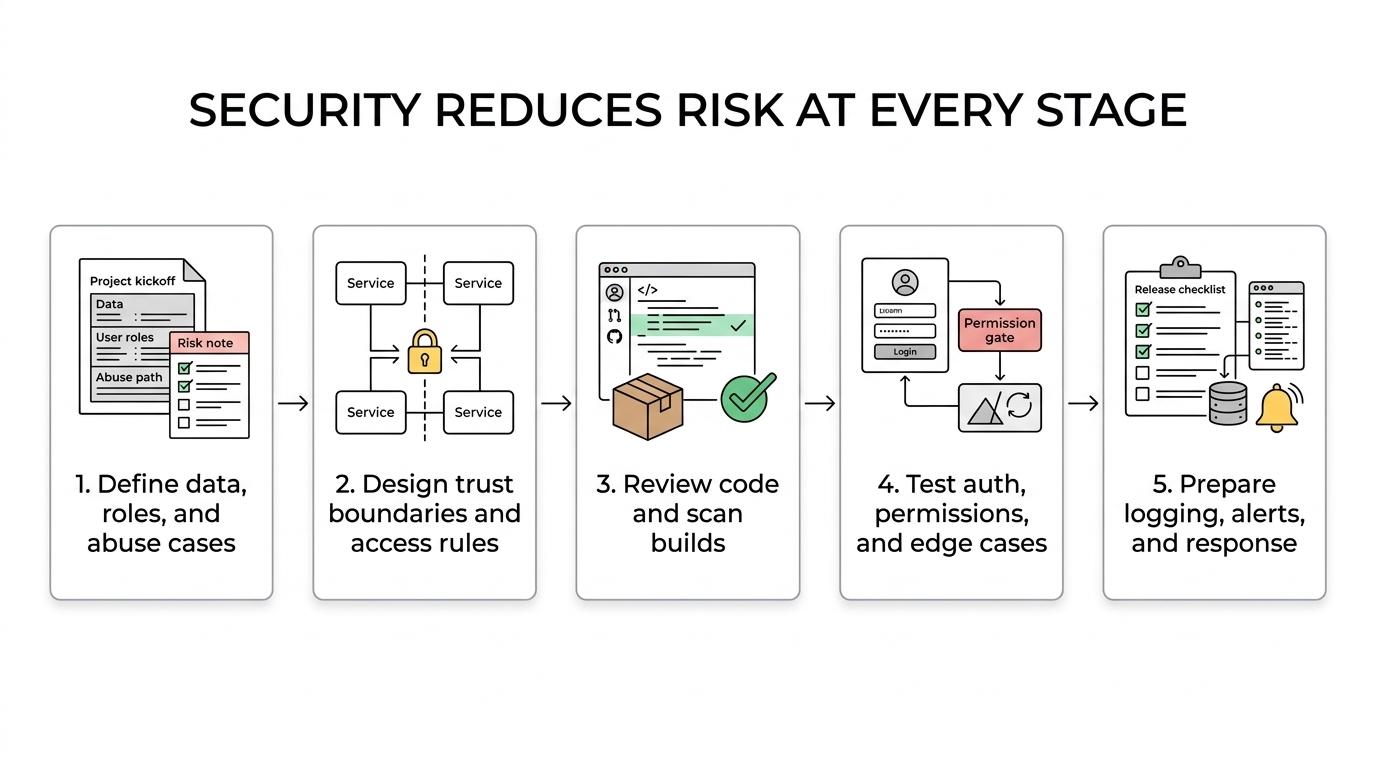
Developers need secure defaults, clear coding standards, peer review, and automated checks that run without friction. Static analysis, dependency scanning, secret detection, and policy checks in CI help you spot unsafe patterns while the code is still fresh in a developer’s mind. That matters because a five-minute fix during a pull request can become a five-day incident after release.
CISA’s secure software attestation focus on secure environments is especially relevant here. Your code can be strong and still be exposed by an insecure build process. If attackers can tamper with pipelines, inject dependencies, or access signing keys, your release process becomes part of the attack surface. Trusted source code supply chains are not an abstract policy topic. They are a direct control against real delivery risk.
A practical secure development flow often looks like this:
| Delivery stage | Security practice | Risk reduced early |
|---|---|---|
| Requirements | Data classification and abuse-case review | Missing controls, weak privacy assumptions |
| Architecture | Threat modeling and trust boundary mapping | Unsafe service design, poor access models |
| Coding | Secure coding standards and peer review | Common coding flaws and insecure logic |
| Build pipeline | Dependency scanning, secret scanning, signed builds | Supply chain compromise, exposed credentials |
| Test | Dynamic testing, auth checks, permission testing | Broken access control, injection paths |
| Staging | Real-world load and misuse testing | Failures under concurrency, edge-case leaks |
| Release prep | Logging, alerting, incident procedures | Slow detection and confused response |
This is where disciplined delivery adds real value. Weekly staging builds and real-world testing help you see how software behaves outside the neat conditions of local development. Security defects often show up at the edges: high concurrency, stale sessions, race conditions, retries, and partial failures between services.
Security testing before launch lowers breach cost
Testing is where many teams treat security as a checklist. That leaves too much on the table. Pre-release security testing should be part of quality, not a separate ritual done right before go-live.
You want more than a one-time scan. You need authentication tests, authorization checks, API abuse testing, input validation checks, session handling review, logging validation, and targeted manual review for high-risk workflows. If your product includes payments, identity, approvals, sensitive content, or public registration, those paths deserve direct attention.
Industry data backs up the financial case. IBM’s 2024 breach findings put the global average cost of a data breach at USD 4.88 million. The same report says organizations with incident response teams and robust security testing saved USD 248,000 per year on average. Organizations with IAM solutions saved up to USD 223,000 each year. Those numbers reinforce a simple point: better preparation changes both the likelihood and the cost of failure.
After you have a baseline testing plan, focus on the checks that tend to expose release-blocking issues fastest.
- Broken access control
- Weak session expiration
- Unsafe file upload paths
- Insecure API authorization
- Missing rate limits
- Exposed secrets in logs
- Dependency vulnerabilities with known exploits
None of these are rare. They are common, repeatable, and very expensive when missed.
Secure software development matters more in regulated and high-load systems
If you build for government entities, enterprises, or public-facing services with fixed launch dates, the stakes get higher. You are not just protecting code. You are protecting approvals, public trust, service continuity, and operational confidence.
Regulated projects often require clearer evidence that security was built into the process. CISA’s attestation approach reflects that direction. Teams are being asked to show good-faith secure development practices, secure build environments, and stronger supply chain control. That means your delivery process needs to produce proof, not just promises.
The pressure increases again when usage spikes are expected. High concurrency exposes problems that small tests miss. Permission leaks, token reuse issues, unprotected background jobs, and race conditions can appear only when traffic rises. Security and performance start to overlap here. A system that fails unpredictably under load can create security gaps even if the code looked clean in review.
You can see this in practical project patterns:
- Public portals: registration, identity checks, approvals, and multilingual workflows
- AI systems: prompt storage, secure content handling, encryption, and real-time synchronization
- Enterprise platforms: role-based access, integrations, audit trails, and admin controls
These are not edge cases. They are common delivery scenarios, especially in the UAE and Saudi Arabia where public deadlines, language support, and formal review are often part of the brief.
Secure data handling and identity design cut risk at the feature level
A lot of security advice stays too abstract. Risk is reduced feature by feature.
If your product stores prompts, generated content, customer records, or operational data, secure data handling starts with where the data lives and who can touch it. Encryption at rest and in transit, efficient indexing that avoids overexposure, retention limits, and well-scoped access policies all matter. Real-time systems need the same care. Fast synchronization should not bypass trust checks.
Identity design is just as important. Single sign-on, session control across devices, role mapping, and privileged admin access need clear rules from the start. Weak identity design creates support issues, audit issues, and breach risk all at once.
When you review a feature, ask yourself whether it introduces one of these common weak points:
- Too much access: users or services can reach data beyond their role
- Too much trust: internal systems skip validation because they are “inside”
- Too much retention: sensitive records stay available longer than needed
- Too much exposure: logs, exports, or analytics reveal data that should stay masked
This kind of feature-level review is where secure development becomes real. You are no longer talking about policy in broad terms. You are making the product safer one workflow at a time.
How to build secure software development into your delivery rhythm
Security works best when it is habitual. You do not need a giant process to get there, but you do need consistency.
Start with a secure baseline for every project. That baseline can include threat review during discovery, minimum coding standards, automated scanning in CI, dependency policy, secrets handling rules, staging tests, and release checks for logs and alerts. When every project begins with the same floor, fewer risks are left to chance.
Then make ownership clear. Product teams should define sensitive workflows. Architects should review trust boundaries. Engineers should fix findings as part of normal sprint work. QA should test permissions and misuse cases, not only expected flows. Operations should prepare alerting and incident procedures before launch, not after.
A steady operating rhythm usually includes a few repeatable habits:
- Weekly staging builds: expose integration and environment issues early
- Security gates in CI: stop known bad patterns before they move forward
- Real-world testing: validate behavior under load, retries, and edge cases
- Post-fix verification: confirm the issue is gone without creating a new one
If you build this into delivery, security stops being a late blocker. It becomes a way to protect timelines, budgets, and product trust at the same time. That is the real benefit of secure software development: you reduce risk while the software is still taking shape, when your team has the most control and the best chance to fix the right thing fast.